

With 27 countries spanning 1.5 million square miles, 446 million inhabitants and 24 languages, the European Union (EU) is the third largest exporter of agricultural and agri-food products consumed in the US. Products produced in the EU not only have a long cultural history steeped in culinary tradition, but are held to rigorous standards denoted by a specially developed set of EU Quality Labels designed to assure consumers are not only getting a top-caliber product, but to also inform them about the product’s background.
The diverse member states of the EU share common food and farming standards that embrace food and worker safety regulations, ensure a high-quality product, emphasize sustainability practices, and guarantee a product’s authenticity. The EU Quality Labels, including PDO (Protected Designation of Origin), PGI (Protected Geographical Indication) and Organic certifications, denote the specific place or region a product originated from and its certified organic status where applicable.
Understanding hows and whys of the labeling categories of products from the EU can help you make more informed choices when choosing these products. The EU’s Quality Label system ensures consumer confidence in products that come from specific areas. These products must pass through strict, validated standards of quality, safety, authenticity, and sustainability.
Of utmost importance, EU Quality Labels support local economies and help maintain traditional production techniques. The validation and protection of these products support small-scale local producers and foster biodiversity and rural development. Products with EU Quality Label certifications are recognized for their superior quality.
From Diverse Regions, EU Sparkling Wines Showcase their Origins
The EU’s sparkling wines are all produced according to the quality standards, described above. Produced all over the EU, sparkling wines that hold the PDO and PGI quality labels reflect the terroir and region they come from. The labels help tell the stories of the place and the shared history of generations of people who have dedicated their lives to producing a high quality product that represents their homeland and the communities who make it.
Europe is the birthplace of sparkling wine, setting the benchmark for those produced around the world. Bubbly is typically associated with holidays and celebrations, but wine regions across Europe produce exciting sparklers that make every day seem special. They are produced in varied terroirs with a range of varietals, resulting in a vast scope of styles and flavor profiles.
Protected Designation of Origin: The EU Quality Label Linking Product to Place

Products bearing the Protected Designation of Origin (PDO) label guarantee that every step of production, processing, and preparation take place within a specific designated geographical region. These products exhibit unique characteristics and qualities that are inextricably linked to the place they’re produced.
PDO sparkling wines must follow strict guidelines. The grapes must be grown and the wine produced, processed, and prepared within the designated area. The wines must be made using specific traditional methods, including aging. PDO sparkling wines are protected against the misuse or imitation of their names and their quality must comply with EU regulations. Common examples of PDO sparkling wines include French Champagne PDO, Italian Prosecco PDO and Asti PDO, Spanish Cava PDO, and Austrian Kamptal PDO.
For example, in Austria’s Kamptal winemaking region, there are small, family-owned biodynamic and regenerative wineries that are designated both with the European Organic Label and with the PDO label. The region is known for its white wines, Sekt Austria Reserve and Grosse Reserve sparkling wines made using the traditional method featuring long lees aging. The area has steep slopes, cool nights, and well-draining soils that add a vibrant acidity to its wines. Along with refined bubbles, they have refreshing, crisp orchard fruit notes like apple and pear and a clean, bright finish.
Protected Geographical Indication: An EU Quality Label Rooted in Regional Heritage
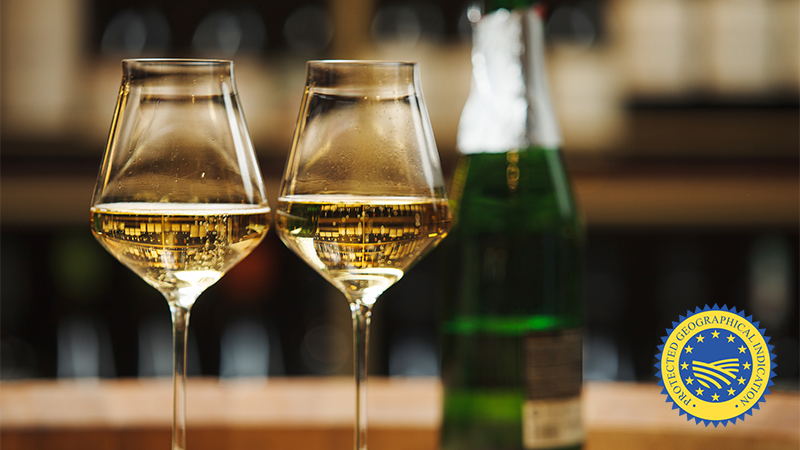
The Protected Geographical Indication (PGI) label protects products whose quality, reputation, or characteristics are intrinsically linked to a specific geographical region. At least one stage of production, process, or preparation must take place within the designated region, guaranteeing that the product’s identity is deeply connected to its place of origin. These wines still adhere to strict quality standards, but have more lenient production regulations than PDO wines.
The grapes used to make PGI wines are grown within a broader geographical area and may use a wider range of grape varieties and winemaking techniques. PGI wines highlight an area’s regional character but allow for flexibility in production and diversity in style. While there’s a wide diversity of EU products and specialties, some of the PGI wines from various regions include: Steirerland PGI in Austria, Sicilia PGI in Italy, Δράμα (Drama) PGI in Greece, and Alentejano PGI in Portugal.
PGI wines can be extremely prestigious. In Italy, for example, the PGI designation allows winemakers in the Toscana IGT (Indicazione Geografica Tipica) to take advantage of the region’s versatility to produce premium “Super-Tuscan” wines outside of the region’s strictest production rules for wines from any of Tuscany’s ten provinces. Wineries in the region are producing a range of red and white wines, including rose and white sparkling wines, some of which are produced using the traditional method and others using the charmat (tank) method.
Organic Certification Means More Sustainable Products
The European Organic Label is given to food and non-alcoholic products that are produced in harmony with nature, minimize their impact on ecosystems, and promote animal welfare. These products are held to the highest environmental and ethical standards and are produced according to rigorous standards that signify a real commitment to sustainability and environmental responsibility. An organic designation can be given alongside PDO and PGI labels, since PDO and PGI labels are connected to the place and process of production. Organic certifications will depend on the wine’s producer.
The use of organic grapes is a reflection of the farming methods that avoid synthetic pesticides and fertilizers, which better supports biodiversity, soil health, and sustainability. Organic farming allows the natural characteristics of the grapes and terroir to be expressed more clearly in the wine’s taste.
The EU Organic logo cannot appear on wine bottles in the US due to the absence of a mutual recognition agreement with the USDA for wine labeling. Though wines imported to the US will not have a European Organic Label on it, the winemakers may themselves indicate that the wine was made using organic grapes, despite not being labeled as such. In this case, the grapes were grown according to European organic farming practices, even if the US wine labeling does not permit the use of European Organic Label.
Because of this cross-regional, European effort for labeling standards, consumers can be sure that every product with an EU Quality System label reflects where it comes from and how it’s made, indicating its excellence, commitment to sustainability, production safety practices, and authenticity. Every sip of a sparkling wine imported from the EU is so much more than simply delicious, they literally bubble up with personal history.
This article was published in partnership with the More Than European Food and Drinks, Savoring Stories campaign.
